

In November of 2011, I received a commission from the Kansas City Symphony and the Nelson-Atkins Museum to write a 21st-century Pictures at an Exhibition. The idea seemed both intriguing and ambitious, and given my own interest in visual art, I welcomed the challenge. After conceptualizing the piece for six months, and visiting the Nelson-Atkins on three different occasions, I decided to compose a series of studies.
Unlike Modest Mussorgsky, who set all of his movements to the work of Viktor Hartmann, my piece brings eight seemingly disparate works of art to musical life. In honor of Mussorgsky and his original work (for solo piano), four of the ten movements were conceived in the form of piano etudes and later orchestrated. My main objective was to create an architectural structure that connected each movement to the next while creating an overall arc for the entire piece.
I used this series as a way of pushing myself both intellectually and emotionally as a composer. I felt inspired and liberated as I gave myself permission to explore new compositional terrain. The outcome is Picture Studies, a 26-minute work for orchestra based on four paintings, three photographs, and one sculpture. Creating this series pushed me in a new direction and allowed me to grow as an artist in the most unexpected ways.
The following impromptu notes were jotted down from initial impressions and repeated viewings of the artwork, after my selections had been made. These original notes helped dictate the form, style, and musical arc of each movement, and ultimately the entire piece.
I. Intro: Ghost-like piano theme (using the piano to pay respect to Mussorgsky) that transports the listener to the inside of the Nelson-Atkins Museum.
II. Three Pierrots (based on Albert Bloch’s painting, Die Drei Pierrots Nr. 2): Comedic, naïve, and excited. A triad will represent the three Pierrots, and throughout the movement the triad will be turned upside down, on its side, and twisted in every possible way. The form will be throughcomposed. End big.
III. Repetition (based on Kurt Baasch’s photograph, Repetition): Four figures walking, and each person is clearly in his or her own world. The idea of repetition can lend itself to an ostinato. This is a photograph, a slice of life, and represents only one moment in time. Take this concept of time and manipulate it. Change the scenery (lighting, shade, color), so to speak, with a shutter click before returning to its original state. ABA form with an abrupt switch to B to represent the shutter click.
IV. Olive Orchard (Vincent Van Goh’s painting, Olive Orchard): Extended impressionism. Colorful, full of love. Perhaps a meeting place for two lovers. Start thin, gradually build to an expansive texture, end colorful. ABC (C references A to show the organic growth of the piece).
V. Kandinsky (Wassily Kandinsky’s painting, Rose with Gray): Geometrically fierce, angular, sharp, jagged, violent, jumpy, and complex. A battleground. Mustard yellow, encapsulates a sustained intensity. Block structures, cut and paste.
VI. Calder’s World (Alexander Calder’s sculpture, Untitled, 1937): As if time has stopped, dangling metal, atmospheric, yet dark. Quasi-aleatoric gestures, perhaps improvised. Gradually fade to niente.
VII. Miró (Joan Miró’s painting, Women at Sunrise): Child-like, yet delirious. There appears to be a sexually ambiguous tone. Try something new, a saxophone or bombastic Eb clarinet solo. Something spontaneous, bouncy, tribal, and raw.
VIII. Interlude: Return of original Ghost-like piano theme with minimal additional orchestrations. Takes us to the final chapter to be played without pause until the end.
IX. Cliffs of Moher (Hiroshi Sugimoto’s photograph, Atlantic Ocean, Cliffs of Moher): Delicate and flowing, find a way to musically represent the ocean and cliffs in the most gentle and subtle means. A return to an ostinato.
X. Pigeons in Flight (Francis Blake’s photograph, Pigeons in Flight): I’ve never looked at pigeons this way. There appears to be so much joy, beauty, and depth. This will be the longest and most expansive movement. Fly away.
Adam Schoenberg
November 1, 2012
.jpg)
Emmy Award-winning and Grammy®-nominated Adam Schoenberg (b. November 15, 1980) has twice been named among the top 10 most performed living composers by orchestras in the United States. His works have received performances and premieres at the Library of Congress, Kennedy Center, New York Philharmonic, The Cleveland Orchestra, Dallas Symphony Orchestra, and Hollywood Bowl.
Schoenberg has received commissions from several major American orchestras, including the Atlanta Symphony Orchestra (Up! and La Luna Azul), Kansas City Symphony (American Symphony and Picture Studies), Los Angeles Philharmonic and Aspen Music Festival and School (Bounce), San Francisco Symphony (Losing Earth), and Louisville Orchestra (Automation). Additional commissions include works for Carlos Miguel Prieto and Orquesta Sinfónica de Minería and Louisiana Philharmonic Orchestra, Jerry Junkin and the University of Texas Wind Ensemble and Texas Performing Arts, and concertos for Anne Akiko Meyer and PROJECT Trio.
Recent and upcoming collaborations include the Phoenix Symphony, Los Angeles Chamber Orchestra, Fort Worth Symphony Orchestra, Boise Philharmonic, Iris Orchestra, Charleston Symphony, Amarillo Symphony, Knoxville Symphony, Arkansas Symphony, and the Nu Deco Ensemble. Recordings include Schoenberg’s orchestral works featuring the Kansas City Symphony, an arrangement of When You Wish Upon a Star for Anne Akiko Meyers and the London Symphony Orchestra, and a compendium including his keyboard works by pianist Nadia Shpachenko. The year 2022 has brought two new releases: “The Blakemore Trio Plays Music of Adam Schoenberg” under the Blue Griffin label, and his Symphony No. 2 “Migration” with the University of Texas Wind Ensemble under the Reference Recordings label.
Adam Schoenberg has received two 2018 Grammy® Award-nominations, including Best Contemporary Classical Composition for Picture Studies. He has been Composer-in-Residence with the Fort Worth Symphony (2015-17), Lexington Philharmonic (2013-14), Kansas City Symphony (2012-13), Blair School of Music at Vanderbilt University (2012) and the Aspen Music Festival & School’s M.O.R.E Music Program (2010-13). He won several awards, including ASCAP’s Morton Gould Young Composer Award for his orchestra work Finding Rothko, the Palmer-Dixon Prize from The Juilliard School and the Brian M. Israel Prize from the Society for New Music. Additionally, Adam Schoenberg received the Goddard Lieberson Fellowship (2020) and the Charles Ives Scholarship (2006) from the American Academy of Arts & Letters, as well as the MacDowell Fellowship in both 2009 and 2010.
An accomplished and versatile film composer, Schoenberg participated in the 2017 Sundance Composers Lab, and has scored two feature-length films and several shorts. Highlights include That Far Corner: Frank Lloyd Wright in Los Angeles (2019 Emmy Award for Best Musical Composition), and Graceland, co-written with his father, Steven Schoenberg, which premiered at the 2012 Tribeca Film Festival and received its nationwide theatrical release in the spring of 2013. He also co-composed the new theme package for ABC’s Nightline.
A graduate of Oberlin Conservatory of Music, Schoenberg earned his Master’s and Doctor of Musical Arts degrees from The Juilliard School. He is currently a professor at Occidental College, where he runs the composition and film scoring programs. He makes his home in Los Angeles with his wife, screenwriter Janine Salinas Schoenberg, and their two sons, Luca and Leo.

Although anxious to pursue the study of music, Modest Mussorgsky was trained for government service, and had to forage around as best he could for a musical education. Considering his limitations—an insecure grasp of musical form, of traditional harmony, and of orchestration—it is no wonder he suffered from profound insecurity. A victim of alcoholism, he died at 46 but left a remarkably rich legacy— authentic, bold, earthy, and intensely vivid Russian music.
Pictures at an Exhibition proved to be a welcome rarity in Mussorgsky’s anguished experience—a composition born quickly and virtually painlessly. Reporting to his friend Vladimir Stasov about the progress of the original piano suite, Mussorgsky exulted: “Ideas, melodies, come to me of their own accord. Like roast pigeons in the story, I gorge and gorge and overeat myself. I can hardly manage to put it all down on paper fast enough.” The fevered inspiration was activated by a posthumous exhibit in 1874 of watercolors and drawings by the composer’s dear friend Victor Hartmann, who had died suddenly the previous year at the age of 39. Mussorgsky’s enthusiastic and reverent homage to Hartmann takes form as a series of musical depictions of 10 of the artist’s canvases, all of which hang as vividly in aural space as their visual progenitors occupied physical space.
As heard most often in present-day performances, Pictures wears the opulent apparel designed by Maurice Ravel, who was urged by conductor Serge Koussevitzky to make an orchestral transcription of the piano set, which he did in 1922. The results do honor to both composers: The elegant Frenchman did not deprive the music of its realistic muscle, bizarre imagery, or intensity, but heightened them through the use of marvelously apt instrumentation.
Pictures begins with, and several of its sections are preceded by, a striding promenade theme—Russian in its irregular rhythm and modal inflection—which portrays the composer walking, rather heavily, through the gallery.
Promenade: Trumpets alone present the theme, after which the full orchestra joins for the most extended statement of its many appearances.
Gnomus: Hartmann’s sketch portrays a wooden nutcracker in the form of a wizened gnome. The music lurches, twitches, and snaps grotesquely.
Promenade: Horn initiates the theme in a gentle mood and the wind choir follows suit.
Il vecchio castello: Bassoons evoke a lonely scene in Hartmann’s Italian castle. A troubadour (English horn) sings a sad song, at first to a lute-like accompaniment in violas and cellos.
Promenade: Trumpet and trombones are accompanied by full orchestra.
Tuileries: Taunting wind chords and sassy string figures set the scene, and then Mussorgsky’s children prank, quarrel, and frolic spiritedly in the famous Parisian gardens.
Bydło (Polish Oxcart): A Polish peasant drives an oxcart whose wheels lumber along steadily (with rhythmic regularity) and painfully (heavy-laden melody in brass).
Promenade: Winds, beginning with flutes, then in turn oboes and bassoons, do the walking, this time with tranquil steps.
Ballet of the Unhatched Chicks: Mussorgsky, with disarming ease, moves from oxcart to fowl yard, where Hartmann’s chicks are ballet dancers in eggshell costumes.
Samuel Goldenberg and Schmuÿle: The names Samuel Goldenberg and Schmuÿle were later additions to the title of this section, originally named “Two Polish Jews, One Rich, the Other Poor.” The composer satirizes the pair through haughty pronouncements from the patriarch (winds and strings) and nervous subservience from the beggar (stuttering trumpets).
The Market at Limoges: The bustle and excitement of peasant women in the French city’s market are brilliantly depicted.
Catacombs: The music trudges through the ancient catacombs on the way to a mournful, minor-key statement of the promenade theme.
Cum mortuis in lingua mortua: In this eerie iteration of the promenade theme, which translates to “with the dead in a dead language,” Mussorgsky envisioned the skulls of the catacombs set aglow through Hartmann’s creative spirit.
The Hut on Fowl’s Legs (Baba Yaga): Baba Yaga, a witch who lives in a hut supported by chicken legs, rides through the air demonically with Mussorgsky’s best Bald Mountain pictorialism.
The Great Gate of Kyiv: Ceremonial grandeur, priestly chanting, the clanging of bells, and the promenade theme create a singularly majestic canvas that is as conspicuously Russian to the ear as Hartmann’s fanciful picture of the Gate is to the eye. —Orrin Howard
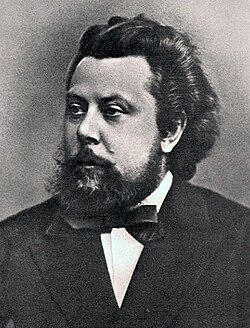
Modest Mussorgsky was one of the five Russian nationalist composers known as the “Russian Five.” He was born to a well-to-do landowner and began taking piano lessons from his mother around the age of six. By the time he was nine, he was playing so well that he began performing for family and friends. In 1852, Mussorgsky entered the Cadet School of the Guards in St. Petersburg . While at school, he showed interest in history and German philosophy, and he sang in the school choir. It was during his first year at school that he wrote Porte-enseigne Polka which he dedicated to his school friends.
In 1857, Mussorgsky left Cadet school and entered the Prebrazhensky Regiment of the Guards. A year later he convinced composer Balakirev to give him composition lessons, but in 1858, Mussorgsky suffered a nervous or spiritual crisis and left the guards to return home. He continued to compose but his music did not gain popularity.
Mussorgsky began working for the Russian government and completed the historic opera, Boris Godunov, which was at first rejected by theatres. At the same time that he was finishing Boris Godunov, Mussorgsky was working on a second opera Khovanshchina.
Through music, Mussorgsky wanted to portray life, however rough and beautiful. When Mussorgsky died, however, he left many of his works unfinished. Russian composer Rimsky-Korsakov took on the task of editing and publishing Mussorgsky’s music.
.png)
Weekday Box Office & Administrative Offices
301 9th Street, Suite 302
Redlands, CA 92374
When visiting, please enter through Door 300.


