
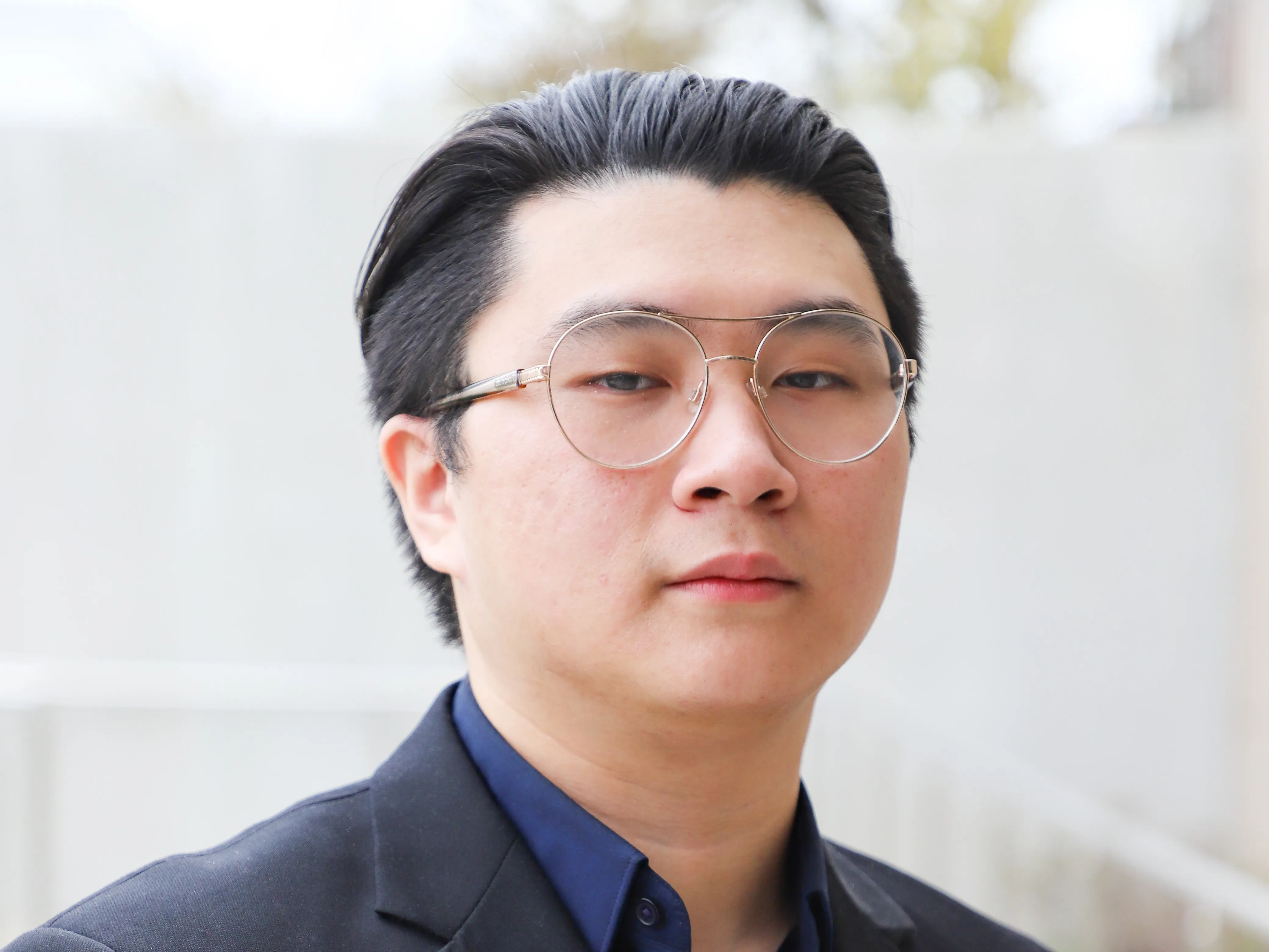


Titled after the opening line from Ocean Vuong’s poem “Immigrant Haibun,” Then, as if breathing, the sea swelled beneath us. is a contemplation of family traditions, dynamics of intergenerational relationships, and the barriers of communication between eras—both spoken and unspoken. Each movement is titled after text that considers these themes of translation, history, and cultural divides.
The first movement “Uống nước nhớ nguồn,” is a Vietnamese proverb meaning “when drinking water, remember its source.” This movement considers filial piety and the responsibilities that are expected of each new generation. A theme introduced by a solo cello starts the piece, which is then morphed and passed down into each movement.
The second movement “But birds, as you say, fly forward”—a line from Li-Young Lee’s “For a New Citizen of These United States” —examines family history and exile, and transforms the first theme into a duet between two violins. The past is what informs our present, but how much should we fixate on this history? In Lee’s poem, the speaker becomes so absorbed with their past that they begin to alienate themselves from their community. Even those who had similar experiences of immigration as the speaker have chosen to move, like the birds, forward with their lives.
Titled after another line from Vuong’s “Immigrant Haibun,” the final movement “I will learn to love a monster” uses a fragment from a popular Vietnamese song, “Tiếng Hát Chim Đa Đa” by Võ Đông Điền, as a melodic ostinato, and the cello theme from the first movement is now integrated into the texture rather than being center stage. In Vuong’s poem, a man names his son after the tumultuous ocean and in many ways himself, as though passing on his own self-destruction to his child. The quoted Vietnamese song speaks of an unrequited love and the process of letting go. To learn is to repeat, and by incessantly repeating this melody, I question these forms of love and how love can better be expressed between generations.
“Huỳnh’s gift for crafting compelling melodies and conjuring timbral atmosphere is evident in Then, as if breathing...” — Chicago Classical Review

Oswald Huỳnh—laureate of a 2026 Guggenheim Fellowship and the 2025/26 Frederic AJuilliard | Walter Damrosch Rome Prize in Musical Composition—is a Vietnamese American composer whose music navigates Vietnamese aesthetics and tradition, language and translation, and the relationship between heritage and identity. His work is characterized by intricate contrasts of timbre and interweaving textures that are rooted in narrative, culture, and memory. Huỳnh has collaborated with the St. Louis Symphony Orchestra, Minnesota Orchestra, Seattle Symphony, Oregon Symphony, Louisville Orchestra, Alarm Will Sound, Akropolis Reed Quintet, Tacet(i) Ensemble, Music From Copland House, and more. Other accolades include the CAG Louis and Susan Meisel Prize, Luigi NonoInternational Composition Prize, and Musiqa Emerging Composer Commission. Huỳnh is represented by Concert Artists Guild.
Composed in 1935, Jacques Ibert’s Concertino da camera is widely regarded as a cornerstone of the alto saxophone repertoire. Dedicated to the renowned saxophone pioneer Sigurd Raschèr, the work highlights the instrument’s agility and its potential for "top-tones" or altissimo register. The piece was premiered in two stages: Raschèr performed the first movement in May 1935, while the full work debuted in December of the same year after Ibert completed the second movement.
The Concertino is written for solo alto saxophone and an intimate ensemble of eleven instruments, comprising a wind quintet plus trumpet and a small string section. Stylistically, it reflects Ibert's distinct neoclassical approach, blending the refinement of French impressionism with the lively, syncopated rhythms of early American jazz. This "short concerto" remains one of the most frequently performed and recorded works for the instrument, celebrated for its "sunny joy" and technical brilliance.
The work is structured in two primary movements. The first, Allegro con moto, is a lively and capricious movement featuring spirited dialogue between the soloist and ensemble. It is characterized by themes that emphasize jazz-influenced offbeats. The second, Larghetto – Animato molto, begins with a soulful, hauntingly lyrical recitative that explores the saxophone's upper register. Without a break, it transitions into a jittery, energetic finale. A short cadenza near the end allows the soloist a final moment of virtuosity before a scampering conclusion.
.jpg)
French composer Jacques Ibert was born in Paris August 15, 1890. His father was a financier, his mother an accomplished pianist, She began his musical training when he was four years old, and despite his father's objection, continued to encourage his ambition to become a musician. Ibert spent a brief time in the family business before enrolling in the Paris Conservatory at age 20, where he studied with Pessard, Gefalge, and Faure, among others.
His studies were interrupted by World War I. He was drafted into the French Navy. Upon returning from his wartime duties he resumed his conservatory training, and in 1919 won the Prix de Rome for his cantata "Le Poete et la Fee" His navy service in the Mediterranean gave rise to his arguably most famous composition, the 1924 symphonic suite "Ports of Call" (Escales). He continued to compose for virtually every genre, including seven operas, six symphonic works and five ballets, three choral works, plus scores of incidental pieces, songs, concertos, and scores for films. He seemed especially partial to woodwinds, composing a number of works for wind ensembles, including a concerto for oboe, concerto for cello and winds, and chamber works for wind ensembles. His Flute Concerto is a standard in the flute repertory.
Ibert's music displays a personality of its own, which deliberately does not follow any contemporary school or musical style. It is, however, very "french" in its humor, whimsy, and lightness. In 1936 Ibert assumed the position as Director of the French Academy at the Villa Medici in Rome, where the Prix de Rome originates. He left this post to return to France during the World War II years, returning in 1946 to continue serving as its Director until 1960. During this time he also served for a year, (1955-1956), as the Director of the Paris Opera and the Opera Comique, and in 1956 was elected chairman of the Paris Academy of Fine Arts. Ibert was married to Rosette Veber (the daughter of impressionist painter Jean Veber), with whom he had two children. He died in Paris, on February 5, 1962, two years after retiring from his post at the French Academy in Rome.

Madelyn Olsen is a third-year saxophone performance major at the University of Redlands. She has studied saxophone with Dr. Andrew Harrison and Dr. Eddie Smith, and is currently a student of Dr. Michael Couper.
Madelyn discovered her passion for music in the Martin Luther King High School Band, under the instruction of Chris Eldred, where she had several solo opportunities on the field and with the wind ensemble. In her senior year, she directed the saxophone choir and quartet which received superior ratings at solo and ensemble festivals.
She currently performs as principal saxophone with the University of Redlands Wind Ensemble and Studio Big Band, and is a member of the University of Redlands Jazz Improvisation Ensemble. Madelyn had the privilege of performing in the 2025 and 2026 President’s Honor Recitals and is a member of the University of Redlands saxophone quartet. In the summer of 2026, Madelyn attended the Saxophone Institute at the Brevard Music Center where she participated in lessons, chamber ensembles and the New Music Ensemble.
Outside of her music studies, Madelyn serves as a University of Redlands Bulldog Ambassador, a Community School of Music instructor and a saxophone section coach for several schools in Riverside. Her prior involvements include working as a Resident Assistant for two years and being the Editor-in-Chief of the student news publication. Additionally, she has received several honors, including the Florina Lupsaiu Award, the John Philip Sousa Award, the Claire Connelly Award, and the Angie Gomez Caring Award.
Madelyn plans to continue her studies at the graduate level, with the goal of becoming a professional performer and educator. She would like to thank her friends and family for their continuous support, her professor for his encouragement and guidance, and the Redlands Symphony Orchestra for their dedication, time and musicianship in preparing for this performance.
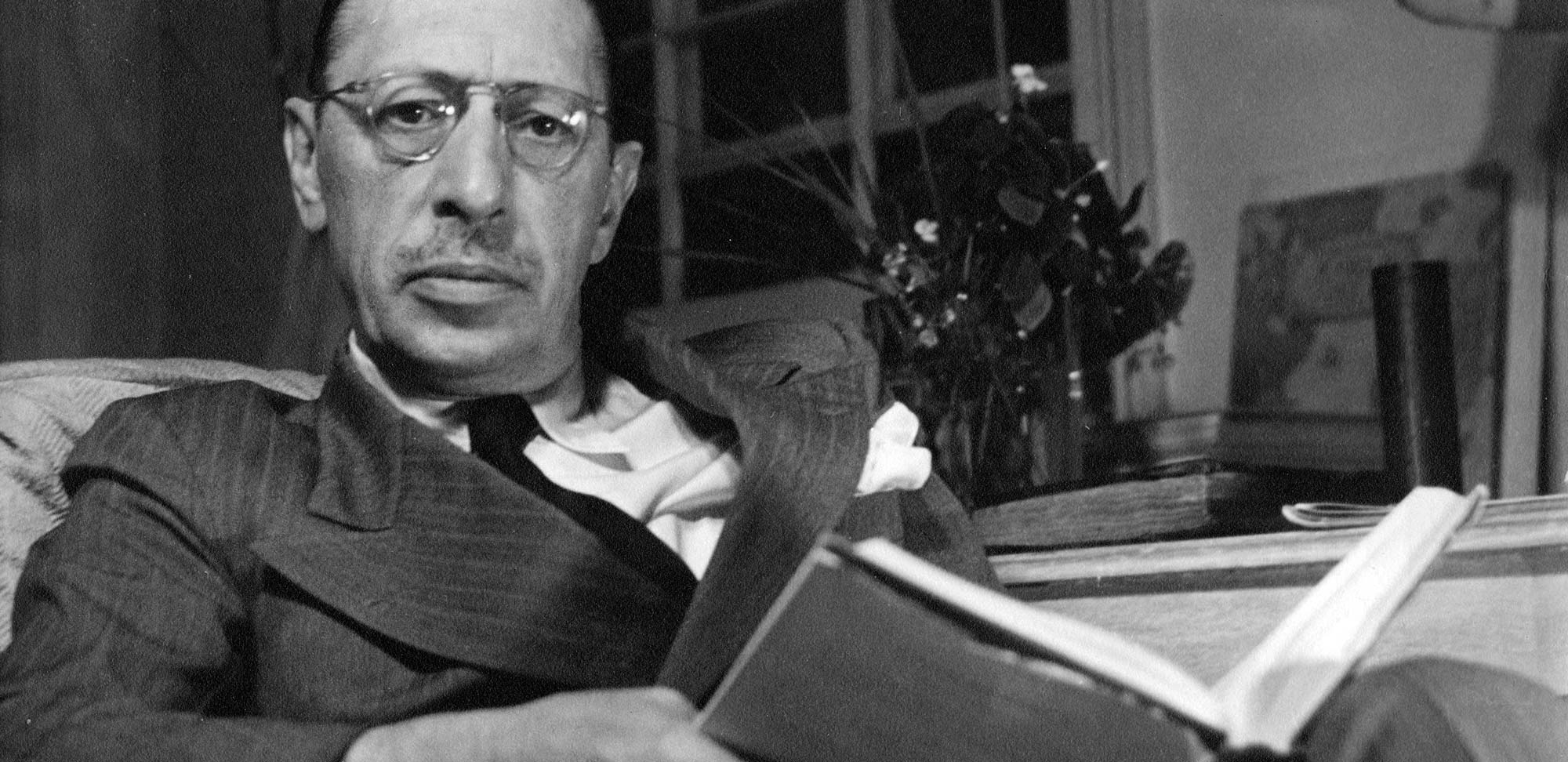
With his company, the Ballets Russes, on tour in the United States, the impressario Sergei Diaghilev spent November 1916 browsing through old music in Italian libraries with choreographer Léonide Massine. When Massine suggested doing a ballet on the Pulcinella stories from the Italian commedia dell’arte tradition, Diaghilev agreed, and the two selected a handful of pieces by Giovanni Battista Pergolesi (or what everyone assumed were pieces by Pergolesi… several other composers managed to sneak into the collection). Diaghilev originally wanted Manuel de Falla to orchestrate the music, but this fell through, and Igor Stravinsky received the commission at the last minute, in the autumn of 1919.
According to Stravinsky, Diaghilev expected nothing more than a “stylish orchestration.” The impresario told Massine that Stravinsky was scoring the ballet for a large orchestra “with harps”. The score Stravinsky presented, however, was for a small orchestra and a trio of singers, and it was not so much stylish as stylized.
The changes Stravinsky made were significant but not fundamental, with few major structural alterations to the music. Stravinsky’s real mark was in his highly idiosyncratic orchestration. The composer explained:
Musical “effects” are usually obtained by the juxtaposition of nuances; a piano following a forte produces an “effect.” But that is the conventional, accepted thing.
I have tried to achieve an equal dynamism by juxtaposing the timbres of the instruments which are the very foundation of the sound material. A color only has value in relation to the other colors which are placed next to it. Red has no value itself. It only acquires it through its proximity to another red or a green, for example. And that is what I have wanted to do in music, and what I look for first of all is the quality of the sound.
I also look for truth in a disequilibrium of instruments, which is the opposite of the thing done in what is known as chamber music, whose whole basis is an agreed balance between the various instruments.
This effect can be heard in the seventh movement of the suite, when the melody appears in a duet between the trombone and solo contrabass, both marked fortissimo. It is clearly impossible for a contrabass to balance the sound of a trombone playing at such a high dynamic. This “disequilibrium” is emphasized when the solo contrabass plays without the trombone in an echo four measures later.
Where Stravinsky alters harmonies and other structural features, it is primarily through manipulation of existing elements in the work rather than insertion of new material. The most dramatic example occurs when Stravinsky orchestrates a trio sonata by Domenico Gallo in the last movement. Under the basic melody, Stravinsky has added insistent tonic chords in an ostinato, shifting in the penultimate bar to a strange dominant chord containing every note but E and B. The F of this chord resolves to an E in the final chord, providing a sense of resolution. However, B, the leading tone, is oddly absent throughout. This gives the ending of Pulcinella a subtly Russian tone, as though the eighteenth-century Italian music were played with a twentieth-century Russian accent— “Scythian eyes seem to glint from behind the mask of European urbanity,” as Richard Taruskin commented.
However, this change is the most drastic in the work, and it occurs at the very end. A look at the piece as a whole reveals that Stravinsky only gradually makes his presence felt. At the beginning, there is little hint that this is anything but a straightforward orchestration of an eighteenth-century piece. As the music progresses, hints of Stravinsky begin to appear. The alterations become increasingly obvious until, by the time we reach the trombone and contrabass duet mentioned earlier, Stravinsky’s hand is blindingly obvious.
Just as Massine performed in a mask stylized to recall the costumes of commedia dell’arte performers, Stravinsky wears a musical mask while orchestrating the music. Both are twentieth-century Russians dressing as eighteenth-century Italians for the evening. Though perfectly capable of disguising themselves, neither can resist the urge to allow his own personality to peek out.
The score for Pulcinella was something new— not an original composition, but more than just an arrangement. This was far more than Diaghilev had expected from Stravinsky, who recalled:
Diaghilev hadn’t even considered the possibility of such a thing. A stylish orchestration was what Diaghilev wanted, and nothing more, and my music so shocked him that he went about for a long time with a look that suggested The Offended Eighteenth Century. In fact, however, the remarkable thing about Pulcinella is not how much but how little has been added or changed.
Positive reviews expressed delight in the novel orchestration, while negative ones tended to proceed from a belief that Stravinsky had vandalized Pergolesi’s music. Constant Lambert commented that he was “like a child delighted with a book of eighteenth-century engravings, yet not so impressed that it has any twinges of conscience about reddening the noses, or adding moustaches and beards in thick black pencil.”
Pulcinella signaled a shift in focus for the Ballets Russes. The company had always specialized in “space travel,” bringing the audience to Persia, Russia, India, and other exotic places. Audiences continued to applaud these works, but Diaghilev knew he needed to be one step ahead. Unfortunately, there were few new places to travel.
In Pulcinella, he found the answer. If space travel no longer accomplished the goal, why not try “time travel”? Stravinsky’s score, Picasso’s scenery, and Massine’s choreography forced the audience to see the eighteenth century through a twentieth-century lens. With this ballet, Diaghilev sent artists with tools of the present into the past to create their work. Stravinsky, at least, was pleased with the result:
Pulcinella is one of those productions— and they are rare— where everything harmonizes, where all the elements— subject, music, dancing, and artistic setting— form a coherent and homogeneous whole.
This piece marked the end of Stravinsky’s “Russian” period. He referred to Pulcinella as “my discovery of the past, the epiphany through which the whole of my late work became possible. It was a backward look, of course— the first of many love affairs in that direction— but it was a look in the mirror, too.” The neoclassicism created in Pulcinella proved to be one of the most important artistic movements of the twentieth century, with effects that continue to resound today.
Copyright © 2015 Chris Myers. All rights reserved. Unauthorized distribution or reproduction prohibited.
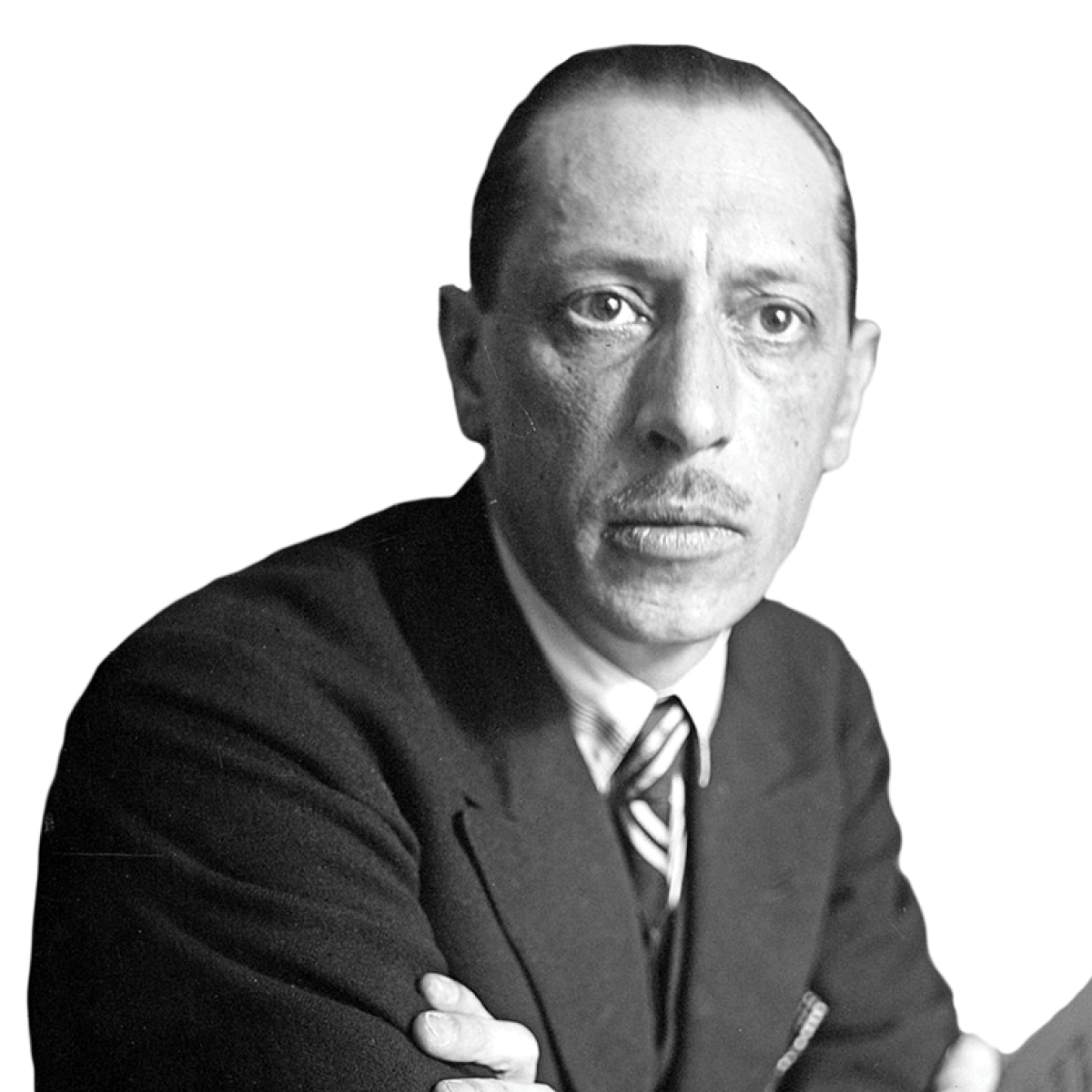
Igor Feodorovich Stravinsky was born in Oranienbaum (now Lomonosov), a Baltic resort near St Petersburg, on 5 June (17 June, New Style) 1882, the third son of Feodor Stravinsky, one of the principal basses at the Maryinsky (later Kirov) Theatre in St Petersburg. Stravinsky’s musical education began with piano lessons at home when he was ten; he later studied law at St Petersburg University and music theory with Fyodor Akimenko and Vassily Kalafati. His most important teacher, though, was Nikolay Rimsky-Korsakov, with whom he studied informally from the age of twenty, taking regular lessons from 1905 until 1908.
Although Stravinsky’s first substantial composition was a Symphony in E flat, written in 1906 under the tutelage of Rimsky-Korsakov, it was The Firebird, a ballet commissioned by Sergei Diaghilev and premiered by his Ballets Russes in Paris in 1910, that brought Stravinsky into sudden international prominence. In the next year he consolidated his reputation with Petrushka, like The Firebird a transformation of something essentially Russian into a work of surprising modernity. Stravinsky’s next major score – a third ballet commission from Diaghilev – is one of the major landmarks in the history of music: the blend of melodic primitivism and rhythmic complexity in The Rite of Spring marked the coming of modernism in music and was met with a mixture of astonishment and hostility. Stravinsky, now a Swiss resident, became established as the most radical composer of the age.
A rapid succession of works – The Nightingale, an opera, in 1914, Renard in 1915, The Soldier’s Tale in 1918, the Symphonies of Wind Instruments two years after that – all reinforced his aesthetic dominance. The explicitly Russian flavour of his music – played out in the Symphonies of Wind Instruments (1920), the opera buffa Mavra (1922) and Les Noces (1923), for four solo voices, chorus and an orchestra consisting of four pianos and percussion – now gave way to a more refined neo-classicism, beginning with the ballet Pulcinella (1920), for which Stravinsky went back to the music of Pergolesi, reworking it into something completely personal.
1920 was also the year that Stravinsky settled in France, taking French citizenship in 1934. Stravinsky expected to be elected to a vacant seat in the Académie française following Dukas’ death in 1935 and felt rebuffed when Florent Schmitt was elected in his stead. His ties to his adopted homeland were further loosened when, in a mere eight months, from November 1938, Stravinsky suffered the deaths of his daughter Lyudmilla, aged only 29, his mother and then his wife (and cousin) Catherine (née Nossenko); faced with an imminent war in Europe, Stravinsky and his second-wife-to-be Vera Sudeikin (née de Bosset) emigrated to the United States. After a year spent on the East Coast, including a stint as a lecturer at Harvard University, he and Vera soon settled in California, where they were to make their home for the rest of their lives.
Pulcinella turned out to be only the first of many works in which, over the next two decades, Stravinsky subdued the music of the past to his own purposes, among them the ‘divertimento’ The Fairy’s Kiss, derived from Tchaikovsky, and the ballet Apollon Musagète, both premiered in 1928. Two choral-orchestral works – the oratorio Oedipus Rex (1927) and the Symphony of Psalms (1930) – showed that he could also work on an epic scale; and it was not long before he tackled a purely orchestral Symphony in C (1938), which was followed within four years by the Symphony in Three Movements. With Perséphone (1934), Jeu de Cartes (1936) and Orpheus (1946), the series of ballets also continued, generally in collaboration with George Balanchine, a partnership as important to dance in the twentieth century as Tchaikovsky’s and Petipa’s had been in the nineteenth. Stravinsky’s neo-classical period culminated in 1951 in his three-act opera The Rake’s Progress, to a libretto by W. H. Auden and Chester Kallman.
One of the most unexpected stylistic volte-faces in modern music came in 1957, with the appearance of the ballet Agon; Stravinsky himself conducted its premiere at a 75th-birthday concert. Hitherto he had ignored Schoenbergian serialism, but in 1952 he began to study Webern’s music intensely and Agon was the first work in which he embraced serialism wholeheartedly, though the music that resulted was entirely his own – indeed, it has a formal elegance that he seemed to have been trying to capture in his neo-classical period. The chief works from Stravinsky’s late serial flowering are Threni, for six solo voices, chorus and orchestra (1958), The Flood, a ‘musical play for soloists, chorus and orchestra’ (1962), the ‘sacred ballad’ Abraham and Isaac (1963), Variations for Orchestra (1964) and Requiem Canticles (1966).
Stravinsky was also active as a performer of his own music, initially as a pianist but increasingly as a conductor. The first among contemporary composers to do so, he left a near-complete legacy of recordings of his own music, released then on CBS and now to be found on Sony Classical. His conducting career continued until 1967, when advancing age and illness forced him to retire from the concert platform. His tenuous grasp on life finally broke on 6 April 1971, in New York, and his body was flown to Venice for burial on the island of San Michele, near to the grave of Diaghilev.
.png)
Weekday Box Office & Administrative Offices
301 9th Street, Suite 302
Redlands, CA 92374
When visiting, please enter through Door 300.


