

Prisms, Cycles, Leaps is Part 1 of the three-part Prisms,Cycles, Leaps Suite. Part 1 bridges the space between Western classical music, music of the Balkans, music of the Volta Region of Ghana, and North Indian Hindustani classical music. My work always seeks to build bridges between different communities through music.
The time signature of the piece is in a foundational 3/2, but shifts its emphasis to 6/4, 12/8, 7/8 + 5/8, and 5/8 + 7/8 in different sections by using different polyrhythmic ostinatos that are found in traditional Ghanaian drumming and dance, specifically from the Eʋe people of the Volta region in Ghana. These polyrhythmic ostinatos are inspired by the Eʋe pieces Atsia Agbekor, Adzro, and Adzogbo, when the gaŋkogui (bell), Atsimeʋu (lead drum), and axatse (shaker) rhythmic patterns combine. Hypermeters are also used to draw attention to larger cycles that occur in the piece.
The melodic lines of Prisms, Cycles, Leaps combine elements of Balkan music and Hindustani classical music. While the melodic lines often use an ornamentation specific to Bulgarian women’s choir music (similar to acciaccaturas and mordents found in Baroque music), the larger form of melodic lines at times use a tihai rhythmic cadence and the long phrases found in improvised Hindustani classical music. Tihai is a thrice-repeated rhythmic phrase in an overlapping meter, where the last note of the third repeat resolves to beat one of the cycle. Tihais are often used to end a section or conclude a piece in Hindustani classical music. The open harmonies found in the music of Aaron Copland and Appalachian folk music also inspired much of the harmonic movement in Prisms, Cycles, Leaps. The title Prisms, Cycles, Leaps refers to a search for beauty in life and nature through multiple and varied yet cyclical experiences.
The Los Angeles Times has described his music as “something to savor” and “enormous fun to listen to,” while The Times (London) has praised Skye’s music as “deliciously head-spinning.”

Derrick Skye is a composer and musician based in the Los Angeles area who often integrates music practices from different cultural traditions around the world into his work with classical music communities. The Los Angeles Times has described his music as “something to savor” and “enormous fun to listen to.” During his studies at the University of California, Los Angeles and the California Institute of the Arts, music across many cultures became an integral part of his musical vocabulary.
Skye studied classical music with Ian Krouse, Alex Shapiro, Paul Chihara, Randy Gloss, and David Rosenboom while also studying West African music and dance with Kobla Ladzekpo; Persian music theory with Pirayeh Pourafar and Houman Pourmehdi; Balkan music theory with Tzvetanka Varimezova; and tala (rhythmic cycles) in Hindustani classical music with Swapan Chaudhuri and Aashish Khan.Skye’s music has been commissioned and/or performed by ensembles including Los Angeles ChamberOrchestra, Albany Symphony, Berkeley Symphony, DaytonPhilharmonic, Los Angeles Master Chorale, Cantori New York, Cecilia Chorus New York, Yale Glee Club, University of Oregon, University of Colorado, Boulder, The National Orchestral Institute, Sphinx Virtuosi, Bridge to Everywhere, Los Angeles Electric8, the Salastina Music Society, Lyris Quartet, Super Devoiche (Bulgarian Women’s Choir), and Lian Ensemble (Persian Ensemble).
Skye has given pre-concert talks and workshops about the use of non-Western music in his compositions at UCLA, USC, the Los Angeles County Museum of Art and the Skirball Cultural Center. He received the New Music USA Award in 2010 and 2011 and was awarded a composer residency with the Los Angeles Chamber Orchestra (LACO) through New Music USA’s “Music Alive” program with LACO for the 2015-2016 season. He served as a panelist for the 2019 League of Orchestras Conference, and previously spoke at the 2016 League of Orchestras Conference on the topic of how classical music orchestras can forge stronger relationships with their diverse communities. Skye serves as Artistic Director of the new music collective and arts organization Bridge to Everywhere.
Skye is an American who has Ghanaian, Nigerian, British, Irish, and Native American ancestry. His ancestry and identity have led him to claim and develop an “American” aesthetic that incorporates many cultural influences into his work, reflecting the diverse communities he is part of. Skye passionately believes in music as a doorway into understanding other cultures and different ways of living. Through learning the music of other cultures, the opportunity for dialogue rather than conflict between strangers is opened, and our society can become one with less conflict due to cultural misunderstanding. He is deeply invested in fostering creative and effective collaboration between artists of different disciplines and traditions.

During the decade preceding the Great War, Mel Bonis made her mark on Parisian musical life. After staying away from salons and concerts since her marriage in 1883, busy with the education of her children, she reappeared in public at the turn of the century to champion her chamber music and piano pieces. Her first successes encouraged her to pursue her artistic path and try her hand at symphonic music. However, she then felt the need to complete her musical training — interrupted twenty years earlier — with Charles Koechlin (1908–1909).
Although the manuscripts of the three pieces that now form the symphonic cycle Femmes de légende (Women of legend) — first published in 2018 — are undated, they were obviously written after these lessons in modern orchestration. The masterful orientalising style, the size of the orchestra and the symbolist ambition of the subjects leave no room for doubt. The piano versions of Salomé (for solo piano) and Le Rêve de Cléopâtre (Cleopatra’s Dream) (for piano duet) date from 1909. One explanation for the lack of circulation of these scores may lie in Mel Bonis’s bitter failure at the Concerts Colonne in 1910: deeply disappointed by the reception of her Fantaisie for piano, she might have thought of giving up composing.
Although she did not do so, she nevertheless stopped promoting her symphonic works and orchestrating her seven pieces dedicated to great female figures (Omphaleis only preserved as a draft).
"My great sorrow is that I never get to hear my music." - Mel Bonis
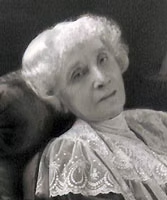
Born in Paris in 1858, Mélanie Hélène Bonis was a lively and strong-willed child. She initially taught herself the piano, before her parents reluctantly allowed her a musical education. Aged 16, she was introduced to César Franck, who gave her piano lessons and showed a great interest in her early compositions. He brought her to the Paris Conservatoire, where – in episode one of our soap opera – she fell in love with Amédée Landély Hettich, a singing student, whose poems she set to music. But Mélanie’s parents disapproved of her marrying into a dangerous artistic world, and forced her to leave the Conservatoire and marry Albert Domange, a twice-widowed businessman, father of five boys and 22 years her senior. Most notably, Albert didn’t like music. The couple had three children, and Mélanie settled into her social duties as “Madame Domange”, putting her scores to one side.
A few years after her marriage, she reunited with Hettich, who had also married. He led her back to the world of music, encouraged her to compose again, and introduced her to her future publisher, as her work began to receive the interest it had always deserved: scores were sold and played in Paris salons. The two were still passionately in love, and Bonis felt painfully torn between her deepest longings and her marital sense of duty. Eventually the temptation proved too strong, and an affair with Hettich led to the birth of a child, Madeleine, who was put into the care of a former chambermaid. Madeleine grew up not knowing who her mother was, but after her foster mother died, she began to spend more time with Bonis, who took her in as an orphan victim of the war and introduced her as a goddaughter.
The emotional toll of leading a double life led Bonis to refocus her energies into music – she composed prolifically, won prestigious prizes, and her music was taken up by some of the most celebrated performers of the time. Butin a heartbreaking twist in her life’s soap opera she was forced to reveal the truth about Madeleine’s parentage by the blossoming of a romance between Madeleine and her (unbeknown to her) half-brother Édouard, Bonis’s son. The confession understandably devastated Madeleine, though over the years mother and daughter did return to being close and eventually lived together after Bonis was widowed.

The Fifth Symphony was written at a critical juncture in Shostakovich’s career, since for the first time (and not the last) he had to confront the peril of Stalin’s displeasure. This was aroused by his opera Lady Macbeth of the Mtsensk District, whose expressionistic intensity and brutal narrative offended the Great Leader. In January 1936, Pravda devoted a ferocious column to condemning the opera. In Stalin’s world, such criticism was life-threatening, not merely career-threatening, which would explain why Shostakovich withheld the exploratory Fourth Symphony he was then working on and composed instead the Fifth.
Even so, he attempted to make amends not with a patriotic cantata or a sycophantic ode but with a symphony, that most formalist of forms, always a mystery to Soviet policymakers, since a symphony without words is not specifically supportive of the regime. The Fifth Symphony, first performed in November 1937, was received with huge enthusiasm and relief since it possessed all the qualities needed to rehabilitate the composer: a simple and direct musical language, extended well-shaped melodies, and, above all, a positive fanfare at the end, erasing all shadows and doubts. At the same time, it has a seriousness and complexity that lifts it well above the level of bland self-abasement that might have been his response.
Shostakovich publicly described the new work as “a Soviet artist’s reply to just criticism.” Privately, he said (or is said to have said) that the finale was a satirical picture of the dictator, deliberately hollow but dressed up as exuberant adulation. It was well within Shostakovich’s power to present a double message in this way, and it is well beyond our means to establish whether the messages are true or false. The listener must read into this music whatever meaning may be found here; its strength and depth will allow us to revise our impressions at every hearing.
The shadows of both Beethoven and Mahler hang over the first two movements, the first movement displaying great ingenuity in the control of tempo from slow to fast and back, and the second couched in a folksy idiom, with traces of the jocular spirit of all scherzos. The third movement is notable for the fine quality of the string writing (the brass are not involved) and its intensity of expression. In contrast, the finale gives the brass and percussion a chance to flex their muscles and hammer home the message of...what? Triumph in the major key, perhaps; pride in a populist regime, perhaps; the mask of jollity concealing the tears beneath, perhaps. The language of music remains forever inscrutable.
—Hugh Macdonald
"I wanted to show... how, through a series of tragic conflicts... optimism as a worldview finds its affirmation." - Dmitri Shostakovich

Dmitri Shostakovich was born in St. Petersburg, Russia on September 12, 1906, and is regarded as one of the greatest composers of symphonies in the twentieth century.
He grew up in relatively privileged circumstances in the pre-Revolutionary era. He attended a private school from 1915 to 1919 where his classmates were children of the elite of society. He had a very musical family, but he wasn’t inspired to begin studying music until he saw his first opera in 1915.
From then on, he showed his musical genius at the piano and also displayed a gift for composition. By 1917, he could play a majority of the contemporary piano pieces and was also composing short piano pieces, most of which were, unfortunately, destroyed.
Eager to get more advanced music training, he entered the Petrograd Conservatory in 1919, where he studied orchestration, harmony, form, and composition with the likes of Maximilian Steinberg, Nikolai Rimsky-Korsakov’s son-in-law. He quickly became famous for his remarkable musical talent.
During the period after the Revolution, most artistic endeavors were severely deprived of money. One of his mentors appealed to the authorities for ration cards and funds for Shostakovich, whose family fortunes had suffered in this period known as the “War-Communism” era.
It was during this period that he developed tuberculosis of the lymph glands. He was then sent to a sanatorium at Gaspra in the Crimea. From this experience, he developed a life-long love of travel.
During his time in Gaspra, he fell in love with a woman who may have been the love of his life, though he was unable to commit to her. Though they did not get married, he continued to write to her long after they separated. Instead, he married Nina Varzar in May of 1932. After they divorced, he married for a third and final time to Irina Supinskaya.
In 1925, he was working on the last movement of his First Symphony in Moscow where he met a number of influential individuals who became friends and mentors. He performed his symphony on May 12 and it was a major success.
The First Symphony’s success brought him international fame, partly because it was the first Soviet composition to become part of the general musical repertory in the West but also because the composer was a teenager.
Shostakovich went on to compose string quartets, concertos, as well as various instrumental and vocal works. He also composed a large number of film scores and theater music as well as ballets.
His musical output was circumscribed by the Union of Soviet Composers, especially his operas. There has always been conjecture about the outstanding music that he might have written had he not had to mold his music to the Soviet standards of acceptable music.
The official pressure was evidenced by the fact that he destroyed almost all the letters he received, never kept a diary, and guarded his conversations with friends and family.
Despite this, he was preeminent in the Soviet Union’s modernist musical world of the 20th century. After years of declining health, he died in Moscow on August 9, 1975.
.png)
Weekday Box Office & Administrative Offices
301 9th Street, Suite 302
Redlands, CA 92374
When visiting, please enter through Door 300.


.jpg)
.jpg)